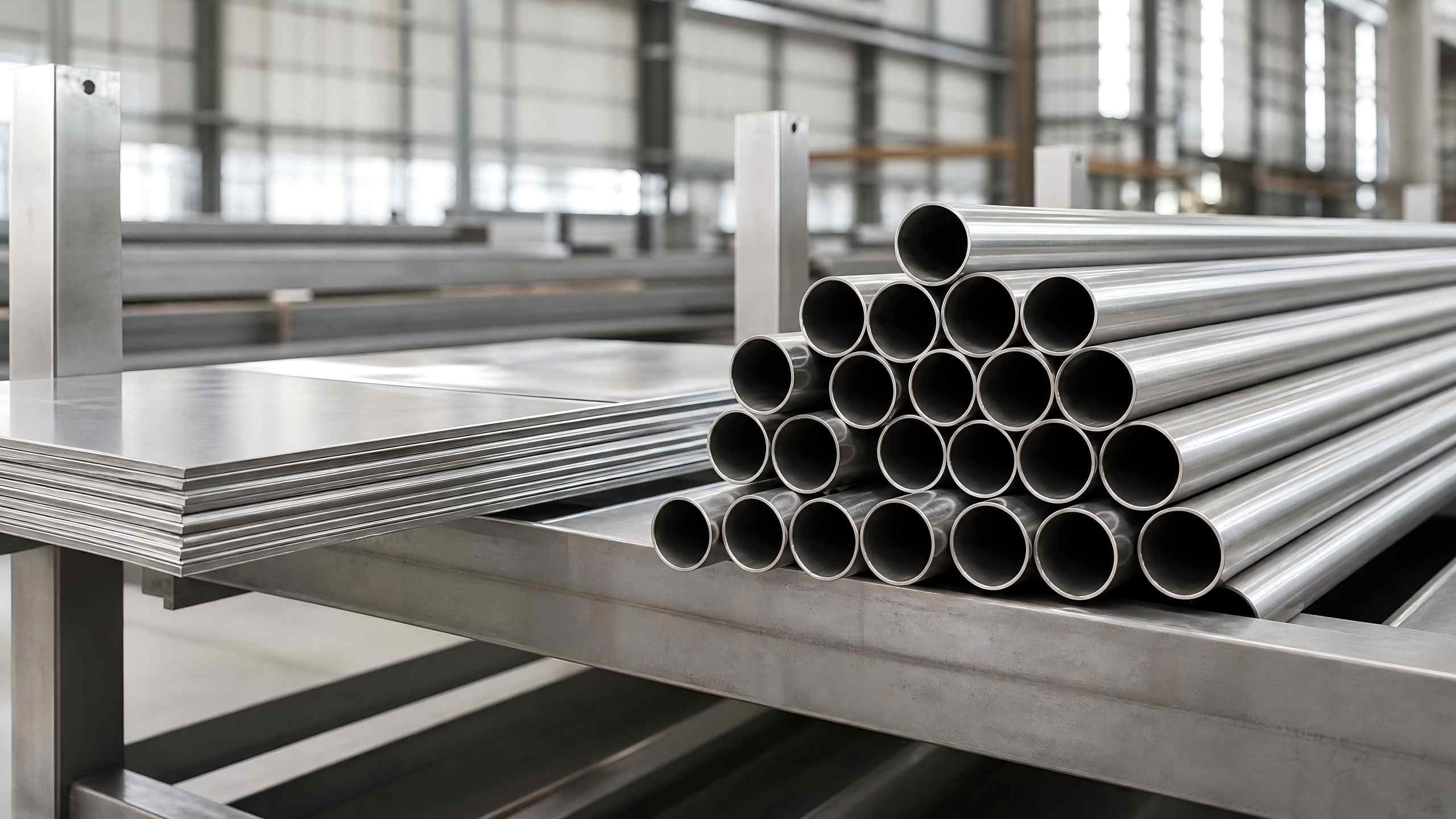
Although 304 and 316 grades look similar in the stainless steel tube industry, they differ greatly in intrinsic performance and applicable scenarios. As your trusted partner, NatureSteel fully understands the importance of accurate material identification for guaranteeing project quality. Their core difference lies in chemical composition, specifically the presence or absence of molybdenum (Mo). 316 stainless steel tubes contain 2%‑3% molybdenum, while 304 contains none. It is the molybdenum element that endows 316 with outstanding pitting‑resistance and chloride‑ion corrosion‑resistance, enabling it to deliver far better performance than 304 in harsh environments such as seawater, heavy salt spray, chemical acids and alkalis.
The performance gap between 304 and 316 essentially stems from differences in chemical composition, and the presence or absence of molybdenum serves as the most critical differentiator.
| Composition | 304 | 316 |
|---|---|---|
| Chromium | 18%-20% | 16%-18% |
| Nickel | 8%-10.5% | 10%-14% |
| Molybdenum | None | 2%-3% |
| Carbon | ≤0.08% | ≤0.08% |
| Manganese | ≤2% | ≤2% |
The addition of molybdenum grants 316 excellent resistance to pitting corrosion and chloride‑ion corrosion. Pitting corrosion is highly concealed and often develops internally unnoticed until severe damage occurs. 316 exhibits far higher stability than 304 in harsh environments including seawater, salt spray, acids and alkalis; by contrast, 304 is only suitable for normal atmospheric and fresh‑water environments and is prone to rust when exposed to chloride ions.
Combined with domestic and overseas inspection and practical standards for tube materials, a complete identification system has been formed within the industry, covering visual screening, tube marking verification, on‑site reagent testing, professional instrument non‑destructive testing and laboratory salt‑spray testing. These methods meet varied requirements for on‑site goods inspection, project acceptance and precise laboratory verification.
1. Visual Appearance Screening
Under identical processing conditions, 304 stainless steel tubes normally show even silvery‑white colour with bright luster; 316, due to higher nickel content, features relatively mild luster, and some tubes may show a faint bluish tint. This method is only for empirical reference. Heavily affected by polishing processes, it cannot be used as the sole judging criterion.
2. Tube Marking Verification
Genuine tubes carry permanent laser‑etched or stamped markings on tube bodies. 304 is usually marked "AISI 304" or "SUS 304", whereas 316 is marked "AISI 316" or "SUS 316". Exercise caution for tubes without markings or with vague markings, and further verify them via professional approaches.
3. On‑Site Reagent Testing
This is an effective on‑site quick‑identification method. Apply dedicated "molybdenum test reagent" onto the polished tube surface:
4. Hand‑held XRF Spectrometer Testing
This is the widely‑acknowledged gold‑standard non‑destructive test in the industry. The device analyses chemical elements via X‑ray fluorescence spectroscopy, accurately reading contents of chromium, nickel, molybdenum and other elements within seconds with an accuracy rate above 99%. Due to high equipment costs, this service is mostly provided by third‑party testing institutions or large‑scale suppliers.
5. Laboratory Salt‑Spray Test
This is a performance‑verification method. Samples are placed inside a salt‑spray cabinet with 5% sodium‑chloride solution for 48‑96 consecutive hours. Rust spots gradually emerge on 304 tube surfaces, while 316 tubes show barely any corrosion signs. This test is only feasible in laboratories and cannot be used for quick on‑site identification.
Test results demonstrate that under long‑term salt‑spray exposure, 304 stainless steel tubes gradually develop rust spots and pitting marks with drastically reduced corrosion resistance. In contrast, benefiting from molybdenum‑driven chloride‑ion resistance, 316 tubes show virtually no rust or corrosion and deliver remarkably superior performance stability. This test is limited to standardised laboratory tests and cannot be adopted for quick identification on construction sites.
| Dimension | 304 | 316 |
|---|---|---|
| Corrosion Resistance | Normal atmospheric and fresh‑water environments | Resists salt spray, acids, alkalis and chloride ions; its corrosion resistance is 2‑3 times that of 304 |
| High‑low Temperature Stability | Moderate | Stronger oxidation resistance above 800℃ and superior low‑temperature toughness |
| Typical Applications | Domestic water supply and drainage, municipal water supply, indoor gas pipelines, general‑purpose machinery | Marine engineering, chemical pipelines, food and pharmaceutical industries, coastal infrastructure |
| Price | Baseline price | 20%‑40% higher |
Neither grade is absolutely superior or inferior; suitability for working conditions matters most. For conventional dry environments, 304 meets requirements with controllable costs. For highly‑corrosive environments such as coastal areas, chemical plants and pharmaceutical workshops, 316 must be selected.
Although 304 and 316 stainless steel tubes look similar, they have vastly different intrinsic performance and applicable scenarios. As your trusted partner, NatureSteel fully recognises how critical accurate material identification is for project quality assurance. Their core distinction originates from chemical composition, mainly whether molybdenum (Mo) is present. 316 stainless steel tubes contain 2%‑3% molybdenum, while 304 has none. Molybdenum grants 316 exceptional pitting‑resistance and chloride‑ion corrosion‑resistance, allowing it to outperform 304 substantially in harsh settings including seawater, heavy salt spray, and chemical acids and alkalis.
🔬 Five Identification Methods: From On‑Site Work to Laboratory
1. Visual Appearance Screening
Under identical processing conditions, 304 stainless steel tubes normally show even silvery‑white colour with bright luster; 316, due to higher nickel content, features relatively mild luster, and some tubes may show a faint bluish tint. This method is only for empirical reference. Heavily affected by polishing processes, it cannot be used as the sole judging criterion.
2. Tube Marking Verification
Genuine tubes carry permanent laser‑etched or stamped markings on tube bodies. 304 is usually marked "AISI 304" or "SUS 304", whereas 316 is marked "AISI 316" or "SUS 316". Exercise caution for tubes without markings or with vague markings, and further verify them via professional approaches.
3. On‑Site Reagent Testing
This is an effective on‑site quick‑identification method. Apply dedicated "molybdenum test reagent" onto the polished tube surface:
- For 304 stainless steel: containing no molybdenum, it turns red or forms dark precipitates within 1‑3 minutes after reagent application.
- For 316 stainless steel: containing molybdenum, it shows no obvious colour change and remains stable.
4. Hand‑held XRF Spectrometer Testing
This is the widely‑acknowledged gold‑standard non‑destructive test in the industry. The device analyses chemical elements via X‑ray fluorescence spectroscopy, accurately reading contents of chromium, nickel, molybdenum and other elements within seconds with an accuracy rate above 99%. Due to high equipment costs, this service is mostly provided by third‑party testing institutions or large‑scale suppliers.
5. Laboratory Salt‑Spray Test
This is a performance‑verification method. Samples are placed inside a salt‑spray cabinet with 5% sodium‑chloride solution for 48‑96 consecutive hours. Rust spots gradually emerge on 304 tube surfaces, while 316 tubes show barely any corrosion signs. This test is only feasible in laboratories and cannot be used for quick on‑site identification.
| Comparison Dimension | 304 Stainless Steel Tube | 316 Stainless Steel Tube |
|---|---|---|
| Corrosion Resistance | Suitable for normal atmospheric and fresh‑water environments | Corrosion‑resistance is 2‑3 times that of 304; resistant to chloride‑ion corrosion |
| Applicable Scenarios | Domestic water supply and drainage, general municipal water supply, indoor pipelines | Marine engineering, chemical pipelines, food and pharmaceutical industries, coastal infrastructure |
| Market Price | Cost‑effective | 20%‑40% higher due to molybdenum and higher nickel content |
⚠️ Common Identification Misconceptions
‑ Misconception 1: Distinguishing with magnets
Thermal‑cold processing and welding alter the magnetism of stainless steel. Therefore magnet strength cannot tell 304 apart from 316; this method can only rule out ordinary carbon steel.
‑ Misconception 2: Judging solely by surface luster
Manual polishing can freely adjust tube brightness and tone, so appearance offers very limited reference value.
‑ Misconception 3: Using general‑purpose nickel test reagents
Ordinary stainless‑steel test solutions can only distinguish low‑grade steel such as 201. They cannot differentiate 304 from 316; "molybdenum‑specific test reagent" must be used.
‑ Misconception 4: Pursuing excessively low prices
Restricted by raw‑material costs, "316" tubes priced far below market average are mostly counterfeit and sub‑standard products.
Material selection shall follow the "fit‑for‑purpose" principle. Choose cost‑effective 304 stainless steel tubes for conventional dry environments; select 316 stainless steel tubes for highly‑corrosive working conditions such as coastal regions, chemical plants and pharmaceutical facilities. Quality inspection should adopt the workflow: preliminary visual screening → marking verification → on‑site reagent testing → precise instrument acceptance, so as to secure project safety and avoid risks.
This guide hopes to deliver clear insights for your project material selection. For stainless‑steel‑tube sourcing, NatureSteel acts as your professional and reliable partner, committed to delivering best‑fit products and solutions.
Address:No. 696, Binhai 12th RoadBinhai Industrial Park, Wenzhou Economic & Technological Development ZoneWenzhou, Zhejiang Province, P.R.China
Copyright © 2026 Nature Steel Group Co., Ltd. All rights reserved. Links| Sitemap| RSS| XML| Privacy Policy