News

What is 2205 Stainless Steel Pipe? A Comprehensive Analysis of Its Properties, Advantages and Application Fields

2026-06-10 0 Leave me a message

In harsh industrial environments such as oil and gas, marine engineering and chemical industries, conventional austenitic stainless steels often fail to meet the dual requirements of high strength and superior corrosion resistance. Against this backdrop, 2205 stainless steel pipe stands out for its excellent overall performance and has become the preferred material for numerous engineering projects. What exactly is 2205 stainless steel pipe? What are its irreplaceable advantages? This article delivers a thorough and clear analysis.

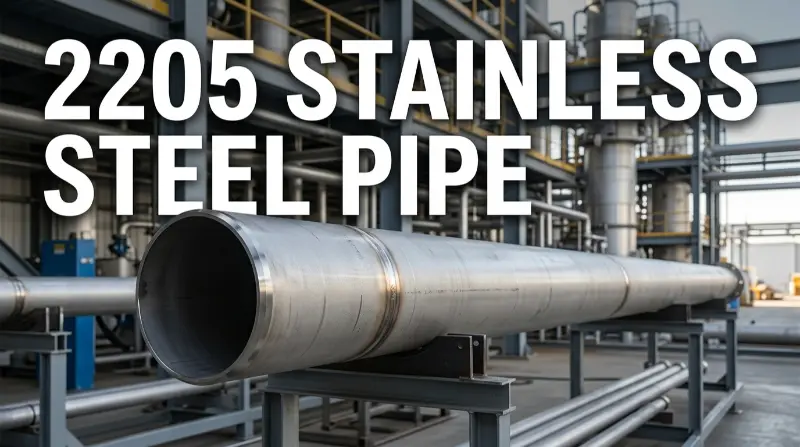
2205 stainless steel pipe

I. Definition and Microstructure of 2205 Stainless Steel Pipe

Simply put, 2205 stainless steel pipe is a typical duplex stainless steel pipe (UNS S32205 / S31803). Its name derives from its unique microstructure: in the solution-treated state, it consists of approximately 50% ferrite phase and 50% austenite phase.

This duplex structure ingeniously combines the merits of two types of materials. The ferrite phase endows the pipe with extremely high strength and excellent resistance to stress corrosion cracking, while the austenite phase delivers good toughness and superior weldability. Thanks to this well-balanced phase composition, 2205 stainless steel pipe achieves an optimal trade-off between performance and cost.

II. Core Chemical Composition of 2205 Stainless Steel Pipe

The outstanding performance of 2205 stainless steel pipe stems from its well-formulated chemical composition. As a chromium-molybdenum-nitrogen duplex stainless steel, its main elemental contents are controlled as follows:


  • Chromium (Cr): 21.0% - 23.0%. It provides fundamental corrosion resistance and forms a dense passive film on the material surface.
  • Nickel (Ni): 4.5% - 6.5%. It stabilizes the austenite phase and improves the toughness of the material.
  • Molybdenum (Mo): 2.9% - 3.5%. It greatly enhances resistance to pitting corrosion and crevice corrosion.
  • Nitrogen (N): 0.14% - 0.20%. As a potent strengthening element, it not only increases the yield strength but also inhibits the precipitation of harmful phases.
  • Carbon (C): ≤ 0.030%. The low-carbon design effectively reduces the risk of intergranular corrosion and ensures favorable weldability.


III. Reasons for Choosing 2205 Stainless Steel Pipe (Core Advantages)

Compared with traditional 304 or 316L stainless steel, 2205 stainless steel pipe boasts three core competitive edges:

1. Excellent Mechanical Strength

The yield strength of 2205 stainless steel pipe exceeds 450 MPa, nearly twice that of conventional austenitic stainless steels such as 316L. When designing pressure vessels or piping systems, engineers can adopt significantly thinner pipe walls, which cuts down equipment weight and material costs.

2. Exceptional Corrosion Resistance

With high chromium and molybdenum content, the Pitting Resistance Equivalent Number (PREN) of 2205 stainless steel pipe generally ranges from 34 to 36, far higher than that of 316L. It features strong resistance to environments containing chloride ions such as seawater and brine, and effectively prevents stress corrosion cracking (SCC), pitting and crevice corrosion.

3. Good Workability and Weldability

Despite its high strength, 2205 stainless steel pipe retains favorable ductility and toughness. It can be cold-bent and formed via conventional metal working methods and delivers excellent weldability. Provided that heat input and interpass temperature are strictly controlled, welded joints can maintain outstanding corrosion resistance and mechanical properties.

IV. Typical Application Fields of 2205 Stainless Steel Pipe

Combining high strength and superior corrosion resistance, 2205 stainless steel pipe is widely used in industries with stringent operating requirements:


  • Oil and Gas Industry: Applied to transmission pipelines for sour oil and gas, subsea pipelines, downhole equipment and high-pressure valves, resisting erosion caused by hydrogen sulfide and chloride ions.
  • Marine Engineering: Used for high-pressure pipelines in seawater desalination plants, structural components of offshore platforms, ship cooling systems, propeller shafts and more.
  • Chemical and Petrochemical Industry: Fabricated into reactors, heat exchangers, storage tanks and linings for desulfurization towers that handle chloride-containing media.
  • Environmental Protection and Water Treatment: Deployed in aeration systems of sewage treatment plants, flue gas desulfurization (FGD) units and pipelines carrying highly corrosive industrial wastewater.


Summary on 2205 Stainless Steel Pipe Selection

To conclude, 2205 stainless steel pipe is an industrial-grade duplex stainless steel pipe featuring high strength, superior corrosion resistance and high safety. Developed specifically for severe working conditions with high pressure and heavy corrosion, it holds irreplaceable advantages in oil and gas, wastewater treatment, chemical engineering and other sectors.

In this field, Nature Steel Group possesses robust manufacturing capabilities and adheres to the business philosophy of "Integrity-based, Win-win Cooperation". It is committed to delivering high-quality material solutions for clients. Selecting premium 2205 stainless steel pipes from Nature Steel Group is undoubtedly a cost-effective strategic material choice.


Related News
Leave me a message
X
We use cookies to offer you a better browsing experience, analyze site traffic and personalize content. By using this site, you agree to our use of cookies.Privacy Policy
RejectAccept